

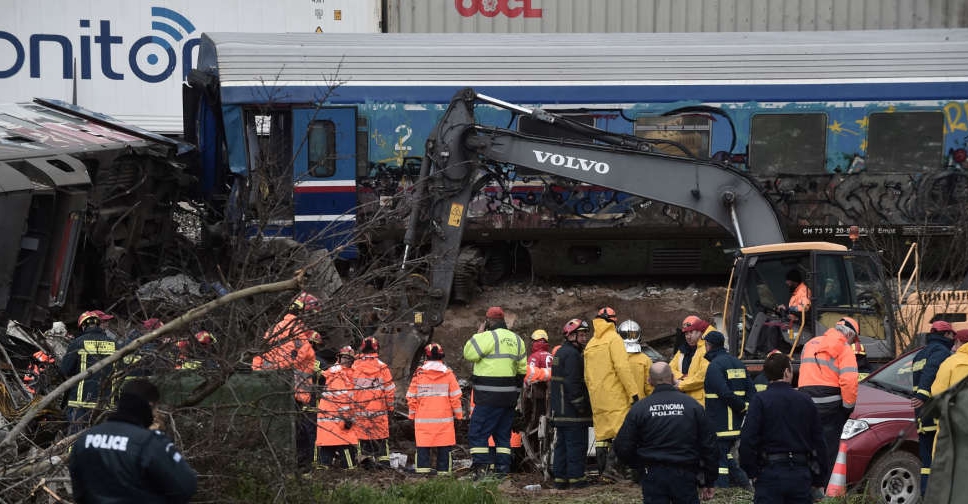
Greek railway workers extended their strike to a second day on Friday, and more protest rallies were planned, amid anger over a devastating train crash that killed at least 57, among them many university students.
Carriages were thrown off the tracks, crushed and engulfed in flames when a high-speed passenger train with more than 350 people on board collided head-on with a freight train late on Tuesday.
"The federation has been sounding alarm bells for so many years, but it has never been taken seriously," the main railworkers union said, demanding a meeting with the new transport minister, appointed after the crash with a mandate to ensure such a tragedy can never happen again.
The union said it wanted a clear timetable for the implementation of safety protocols. Questions around the crash - which happened as the two trains were on the same track - involve faulty signalling and maintenance issues.
Work resumed at the crash site, where rescue staff used cranes to lift some of the carriages that were thrown off the tracks - which could be wrapped up on Friday.
"The operation is under way, it was planned to end today, we hope it will end today but there's always the unknown factor," a fire brigade official said.
It was unclear if more were still missing, or how many.
Amid shock and sorrow in a country where three days of national mourning have been declared, families and friends said they wanted answers over how such a crash could have happened.
After evening protests over the past two days, two more protest rallies are planned in Athens on Friday, around noon and in the evening.


 Ukraine urges acceleration of peace talks
 Japan's Takaichi set to secure big majority in lower house election
 Thailand votes in three-way race as risk of instability looms
 Meloni condemns 'enemies of Italy' after clashes in Olympics host city
 Australia's opposition coalition reunites after split over hate laws
 Trump condemns, won't apologise for video with racist clip on Obamas
 Search for Nancy Guthrie, missing 6 days from Arizona home, turns to new message
 WHO says one person dead from Nipah virus in Bangladesh